


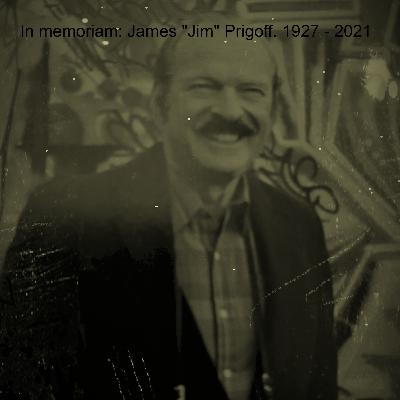
In memoriam: James "Jim" Prigoff. 1927 - 2021
Description
I did not know Jim Prigoff well but was
delighted to be able to ask him a few
questions during the Urban Creativity
Conference in 2020, when he participated in
an on-line Q&A session together with Henry
Chalfant and Susan Farell.
Jim answered candidly and made quite a lively
impression in spite of his respectable age.
We stayed in touch after the conference via
e-mail, discussing the origins and
trajectory of style writing and were
plannning an audio interview for my podcast.
That was, sadly, never to be recorded but
he did humbly devote the time and effort to
type down some lenghty and super interesting
answers to some of the many questions I had.
I was planning to try and get it published
as an article sometime down the line but
learning of Jims recent passing, it feels
more appropriate to make it available here,
for free and as a tribute to his work.
This interview was conducted on the 20:th July 2020.
I am very happy that I got the chance to
thank the man for producing works as
Spraycan Art. A book that left an immense imprint
on me, and so many other kids in the 80´ies with over 250 000
sold (racked?) units.
It was tremendously inspiring to discuss various
graffiti-related topics with a man of such
insights and passion for art and culture
As a graffiti writer and chronicler:
I salute you Mr Prigoff!
SGP: To graffiti-aficionados, I would claim
you became a household name in conjunction
with the release of the book Spraycan Art.
By then, in 1987, you were 60 years of age.
I would like to know what you did before
this.
What was your childhood like and what was
your relation to art and expressions in the
public space before graffiti came along?
Jim: My life history was that of a middle-
class child growing up in suburban NY. There
was every expectation that I would go to
college, get a good job, and have a
successful business career. My mother took
me to Museums and in general I was a
visually oriented person. At age 40, I
became interested in tracking and
documenting murals and community art
particularly as it had political reference.
I began to see tags appearing and
photographed some. As the art form developed
and became more sophisticated, I
incorporated it into my mural search wanting
to give dignity and respect to this new
burgeoning form of art expression.
SGP: What are your earliest meetings with, or
memories of (style writing)graffiti and what
did you make of it?
Jim: I remember seeing BIO, BRIM, MED, T-KID
TAGS in the Bronx and then some of Keith
Haring’s characters in the early 80’s. A
Samo here and a Sane there. Going to
Freedom’s tunnel on the west side. Tracking
Lee, Vulcan, Daze, Crash, Blast, Phase 2,
Tracy and so many others.
SGP: How did you go about approaching it and
learning more about it?
Jim: In the early eighties I began to meet
some of the writers, particularly on the
west coast when I moved in 1981. The TMF
crew, TDK crew and TWS, writers that I am
still in touch with to this day. Also, many
of the writers in LA like Slick, Hex, Chaz,
Risk etc.
As the writing moved from tags to pieces, I
recognized the skill involved and became
interested in following its development as
well as to give respect and dignity to those
creating the art.
I watched the writers creating their pieces,
talked to them about the culture to
understand their motivation,
creativity, and how it was becoming such an
important part of their lives. I remember
inviting the TMF crew to my home in SF. to
do an in-depth interview with them.
SGP: When did you first cross paths with
Henry Chalfant and how did you come to work
on the book together?
Jim: Tony Silver came to see me when he was
working on Style Wars, hoping I would have
some ideas for fund raising to help finance
the film. He mentioned his film partner,
Henry Chalfant and suggested I should meet
him when I was next in NYC. When I decided
to do a book of how the art came above
ground from the NY City subway system, began
to appear on walls and handball courts and
then move across the country, I wrote and
invited Henry to join me. His reply was “My
brain is Graffitied out. But let’s do it”.
SGP: We recently spoke about the process of
selecting what works and cities that were
featured in the final product (Listen to the
snippet published in this post)
Could you speak a bit about the response and
critique the book received and any tangible
proof of its impact on subsequent
travels/interactions the coming years?
The first trip to Sweden for example.
Jim:The book received an instant positive
response world-wide. It was voted one of the
50 best books for layout and design in
Britain in 1987. There were many newspaper
reviews and received commendation in a NY.
Public Library list. Henry was already
recognized internationally and with the
publishing of Spraycan Art, I became very
visible and invited to speak in venues
around the world.
SGP: Did you at any point feel a
responsibility in regards to the amount of criminal
damage/defacement that the book inspired?
And, without rehashing the old "Art or
Crime" debate; how big a part of graffiti do
you think the illicit nature of it is/contra
the artistic aspect?
This could be expanded into a discussion of what
happens when graffiti is brought on to
canvas and the transition into the field of
fine art and museums, certainly.
Jim: My chosen role in the movement was that
of a photo documenter to preserve the images
which often disappeared rapidly, to present
the art form to as large an audience as was
possible and to be its advocate. Also, to
help understand its social context within a
capitalist society. There is no question I
played a contributing part in the larger
picture/puzzle. People are welcome to
ascribe whatever they want as to my
influence because almost all of the feedback
has been very positive. Kids I didn’t even
know have told me I saved their lives as
they left the gang culture and moved to
Graff. Many of their friends left behind
were R.I.P. Graffiti moving to Museums and
fine art is partially a result of writers
getting older, gaining attention, needing to
support families etc. But that is just one
of the many facets in an ever far reaching
development.
SGP: With the spreading of style writing now
having reached most corners of the world.
What are your impressions on how it has
evolved in respective geographical areas.
I.e I see tendencies of simply imitating
classic NY Subway Graffiti, with western
letters/words and the same old styles and
aesthetics in all parts of the world.
It has its charm I suppose but can
also feel shallow and bleak somehow.
Are there any scenes where you think an
exciting adaption and furthering of the
artform has taken place?
Jim: This question is complex and better
answered by the artists themselves. There
were so many ways that writers chose to
develop style. First, many just copied from
the books or had mentors who taught them
style. But as time went on, writer explored
new imagery and style often became regional.
SGP: Having dedicated such a large part of
your life to chronicling and collecting
graffiti. Why has this movement been so
important to you, and perhaps any guesses on
the attraction and meaning it has had to so
many? In short; what is so great about
graffiti?
Jim: Graffiti documentation has been part of
a much larger interest in tracking painted
murals, particularly as they related to
community issues, political attitudes and
their influence in public visual life. For
me it was a way to combine an interest in
photography wi













 United States
